
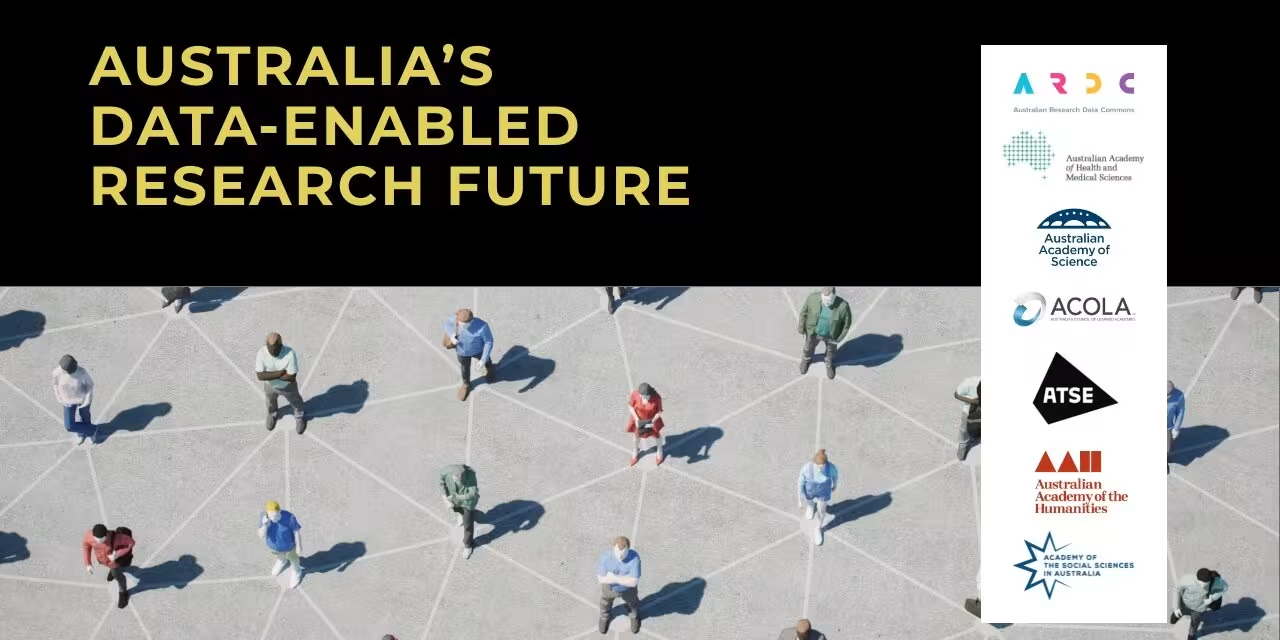
Realising and Enabling Australia’s Data-Enable Research Future
The pandemic and recent natural disasters have highlighted the importance of rapid access to data to assist with timely decision making, and subsequently the need for coordinated, integrated data infrastructure.
Data for research come from a range of sources: observations, images, sound, measurements, samples, computer programs and recordings. They can also be numerical, descriptive or visual, and can be raw, cleaned, analysed or processed. Data is also coming from a wider source from more powerful and ubiquitous sensors (e.g. environmental sensors and wearable devices) to social media which offers unprecedented observations of societal dynamics. With this, researchers will be able to explore topics never before accessible in ways that can benefit Australia and the world.
More data will enable researchers to make more accurate observations, predictions and understandings of potential unintended consequences leading to more robust research findings, improved innovations and better insights for public policy.
However, we lack the skills, resources, tools and technologies to leverage this opportunity to its full extent, to develop new knowledge and address real world.
This is why the Australian Research Data Commons (ARDC) partnered with the Australian Council of Learned Academies (ACOLA) and the five Learned Academies to help build a more coherent data policy and uplift our national data capabilities for researchers. Leveraging the deep expertise and experience of Academy Fellows and the ARDC’s data infrastructure expertise this project has delivered a series of environmental scans into actions and investments to realise a vision for Australia’s data-enabled research capabilities. A synthesis report was also developed that draws out common themes and opportunities and needs for multidisciplinary research.
There are three key actions needed to support data-enabled interdisciplinary research:
1. advocating for investment in data as a public good, including beyond STEMM disciplines and industry
2. driving real action to implement the FAIR1 and CARE2 principles
3. focusing on the shared governance and capability development for Australia’s data future while maintaining a ‘watching brief’ on distinct discipline-specific needs
The Australian Learned Academies’ Future of Research Data project worked to understand and improve the coordination of research data priorities across disciplines. The project combines the leadership and strategic insights of the Academies and ACOLA with the national data infrastructure expertise of the ARDC.
Firstly, each Academy assessed how data assets are currently used within their discipline areas and what is needed to enable better utilisation in the future to achieve world-class research. Academies undertook extensive consultation, ran workshops, and completed scenario analysis, surveys and desktop research.
This document identifies the key findings from across the Academy reports aimed at enabling world-leading interdisciplinary and multidisciplinary research by maximising the value of data and ensuring we have robust national data capabilities.
The reports highlight three key areas for action:
further investment in data, as a public good, but especially for research and innovation
real action is needed to implement the FAIR (Findable, Accessible, Interoperable and Reusable) and CARE (Collective benefit, Authority to control, Responsibility and Ethics) principles
- there are actions for all stakeholders in leading change and building capability to realise Australia’s data future.
Quality data underpin effective policy and decision making. Researchers are accessing, creating and sharing more data than ever, providing insights that can benefit Australia and the world, in fields such as healthcare, environmental management and urban development.
However, the increasing volume and variety of data bring challenges for effective and consistent planning, access, management and storage to support world-leading research. Australia’s data infrastructure, assets, policies and skills must keep pace with the opportunities from the growth of data, especially for multi- and inter-disciplinary data-driven research. Data policies, infrastructure and assets vary across jurisdictions.
In 2021, the Australian Research Data Commons (ARDC) partnered with Australia’s five Learned Academies and the Australian Council of Learned Academies (ACOLA) to ensure Australia can undertake excellent data-enabled research across all fields of research. Importantly, this project sought to help develop a more coherent data policy and strategic data planning environment to underpin national (system-wide) data infrastructure. We recognise that different disciplines have different requirements, although there are some common challenges and opportunities. However, it is also worth noting that interdisciplinary research has specific needs and requires coordinated support. New forms of data and technology, such as social media and Artificial Intelligence (AI), will deeply affect research and knowledge creation; they require new ways of capturing, storing, annotating, and analysing data.
There are three key actions needed to support data-enabled interdisciplinary research:
1. advocating for investment in data as a public good, including beyond STEMM disciplines and industry
2. driving real action to implement the FAIR1 and CARE2 principles
3. focusing on the shared governance and capability development for Australia’s data future while maintaining a ‘watching brief’ on distinct discipline-specific needs.
As part of our response to the challenges, it is vital that the Academies and ACOLA engage deeply in the development of the Australian Government’s proposed National Digital Research Infrastructure Strategy, under the 2021 National Research
Infrastructure Roadmap, to ensure a fit-for-purpose and future-proof approach to Australian research data.
Delivering upon the challenges will lead to:
• enhanced public awareness, dialogue, social licence, and acceptability for data use
• improved data management and standards, including sharing of code and workflows
• improved data access and sharing to facilitate and maximise the use of all forms of data, (including human data), including between governments, academia and industry, and
• improved skills and training across all levels of the research system.
- Australia’s Data-Enabled Research Future Technology and Engineering 2022.pdf
- Australia's Data-Enabled Research Future- Social Sciences 2022.pdf
- Australia's Data-Enabled Research Future- Science 2022.pdf
- Australias-Data-Enabled-Research-Future-Humanities.pdf
- Australias-data-enabled-research-future-health-and-medical-sciences.pdf
- Australias-data-enabled-research-future-health-and-medical-sciences_appendices.pdf