

Australia is one of the most urbanised nations in the world, with almost two thirds of the population concentrated in five metropolitan areas.
Projected urban expansion, and the residential expectations of many Australians, are raising acute questions relating to the planning and provision of social, economic and physical infrastructure, with mobility and accessibility at the centre. The capacity for Australia to transition to affordable, reliable, low emission transport will underpin the future security of the mobility of people and goods. This project will synthesize cutting-edge research on alternatives which look at optimising the transport system for lower emissions within and between innovative urban infrastructures, and will examine effective ways to counter the institutional and cultural obstacles to transformational change.
“Australian cities are under pressure and we need to find a way of putting people first in urban transport and planning. New technology can be part of the solution but what we need is long-term, nimble policy development that incorporates the benefits of science and innovation as well as many other disciplines.”
Professor Ian Chubb /
This report begins by setting out the urban mobility challenge. Individual chapters then explore specific issues grouped into transport technology; public health, safety and the environment; social issues; and economics. The final chapter seeks to pull those different dimensions together, demonstrating that a paradigm shift in favour of sustainable urban mobility planning can offer a framework in which to address many of the issues raised. The report takes a holistic, future-seeking approach to planning.
Australian cities are vulnerable
Despite historically successful urban development, Australian patterns of settlement, urban infrastructure and social organisation are vulnerable to increased urbanisation, changing demographics, diminishing resources, climate change and the increased frequency of extreme weather events.
Australian urban environmental footprints are not sustainable
Australian cities rank high on measures of ‘liveability’, but they demonstrate environmental footprints that are not sustainable. Sydney’s geographic area of 2037 km2 exceeds that of London (pop. 10.23 mill). Berlin (pop. 4 mill) has a density of 3000 people/km2 double that of Melbourne. The expansive nature of Australia’s largest cities has environmental consequences and implications for transport.
Three strategies are key in improving urban sustainability
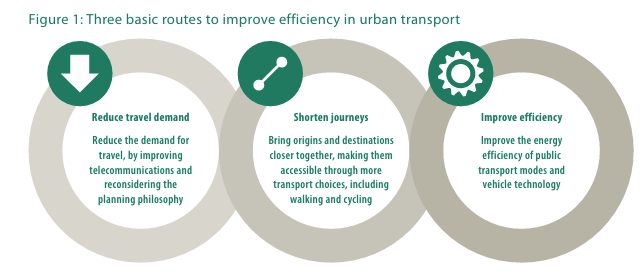
Sustainable urban mobility planning involves the consideration of a three-pronged approach: reduce or avoid travel or the need to travel; shift to more environmentally friendly modes of transport; improve the energy efficiency of transport modes and vehicle technology.
Technological innovations are important
Increasingly, the use of information and communications technology will facilitate urban management, ranging from data applications for planning and transport management to city policing and the timely allocation of resources and services. Technological innovation is important in helping to mitigate greenhouse gas emissions, reduce trip times and minimise traffic accidents. Technology alone, however, cannot solve the challenges ahead.
Limited fuel stocks are a major national risk
Australia has small and declining fuel stocks, holding no more than three weeks’ supply of oil and refined fuels onshore. Australia is consistently the only one of the 28 member countries that fails to meet its International Energy Agency (IEA) 90-day net oil import stockholding level. This might be regarded as a major national risk.
Greenhouse gas emissions are growing not declining
Australia is one of the world’s highest emitters of greenhouse gases per capita. Greenhouse gas emissions from the transport sector are, relatively, particularly high—in some cities three times those of London and still growing. Australia is likely to face international pressure to achieve a dramatic change in order to contribute to the global challenge to limit warming to 2°C.
The transport sector is inefficient—this incurs costs
The Australian transport sector does not rank well on efficiency against some international measures; transport inefficiencies carry costs. The cost of moving freight by road (over distances of more than 1000 km) are more than double that of rail, while greenhouse gas emissions for road are more than triple those for rail. The average motorcar is parked at home 80% of the time, parked elsewhere 16% of the time and on the move only 4% of the time.
Inadequate infrastructure restricts productivity and incurs costs
Experiences of transport networks failing to keep pace with demand, water quality standards being uneven, energy costs being too high, telecommunication services being outdated, or freight corridors being neglected are now so common that they necessitate a strategic response (Australian Infrastructure Audit 2015). There are quantifiable economic, environmental, public health and safety impacts to the infrastructure deficit.
Several key enabling technological innovations are evident
Specific technological innovations will help to mitigate some transport challenges. Three examples are: plug-in electric vehicles (PEVs), which will have a direct impact on the sector; high-speed broadband (HSB) which will continue to expand its impact on urban mobility generally; and the ‘Internet of Things’ (IoT), expected to become a major enabler in the urban mobility sector. The IoT is the network of physical objects embedded with electronic components that allow those objects to be sensed and remotely controlled. ‘Objects’ range from medical implants through automobiles with built-in sensors to search and-rescue technology.
Policy development needs to be nimble to match rapid change
Innovation in transport is moving quickly. Policy often lags behind technological innovation in the transport sector; planning approaches should be nimble enough to take advantage of rapid developments.
The growing, ageing population presents particular urban challenges
By 2050, the Australian population is expected to reach 37 million, which will almost double the number of people in Melbourne, Sydney and Perth. All capital cities will have an increasing proportion of older people over the next half-century. This has significant implications for a range of planning and design activities, from housing and transport, to the delivery of human services and the size of local workforces.
Inner city living is becoming denser; outer city living risks being marginalised
There are two distinct trends occurring across the largest of Australia’s cities: one of growth locating at low densities on the urban fringe and the other of growth consolidating in high density city centres. A lack of polycentricism in planning leads to low-density residential expansion of cities (‘sprawl’) and places those in outer urban and inner-regional areas at risk of transport poverty.
Transport poverty
An increasing number of people are living further away from central business districts and employment hubs. Fringe developments are characterised by low housing and low employment density, limited (if any) mixed use development and poor access to public transport. Together this increases distances between where people live and where they need to travel for work, shopping, socialising and recreating. In these motorcar dependent neighbourhoods, residents are at risk of transport poverty.
The cost of urban congestion will increase four-fold in two decades
Without investment in additional capacity or demand management innovations for current infrastructure, the economic extent of congestion costs in Australian capital cities is forecast to grow from $13.7 billion in 2011 to around $53.3 billion in 2031 (State of Australian Cities 2014–15).
The majority of Australian children are no longer actively mobile as commuters
More than 60% of children in Australia are now driven to and from school; this constitutes as much as 17% of peak traffic. Chauffeuring of children, during the week and over weekends, contributes significantly to traffic congestion. It also counters the benefits of active modes of transport (walking, cycling, skateboarding, etc.), which increase physical activity and help to prevent obesity.
Planning for the origin-destination distance is key to sustainability
A transition to more localised patterns of living will help to reduce or avoid the need for travel. Planning for sustainable urban mobility, including shortening the distance between origins and destinations, contributes to this goal.
Access to multi-modal transport choices promotes sustainability
The availability and frequency of multi modal transport choices is key to improving accessibility and the ability to benefit from opportunities. Access to opportunities such as education, employment and health care promotes social equity and contributes to economic growth.
Economic progress is not evenly distributed
Within and between cities, economic progress has not been evenly distributed against a number of economic indicators. Infrastructure plays a key role in improving the productivity of Australia’s cities (State of Australian Cities 2014–15).
Australian cities have a significant infrastructure deficit
The available international comparisons suggest that, despite recent increases in government spending and increased private participation, the overall quality of our infrastructure lags behind comparable nations.
Infrastructure requires a spend in the order of $350 billion over ten years
An Australian infrastructure deficit has built up over the last forty years, estimated in 2014 by the Department of Prime Minister and Cabinet to amount to $100 billion. Further analysis for this report suggests that the national shortfall by 2025 (and the cost of preventing the development of further backlog to that point) requires an infrastructure spend in the order of $350 billion over the next ten years.
Integrated planning is essential
Reforms will be essential to integrate land-use planning and the implementation of sustainable urban mobility principles. Engagement with industry including the design, construction and transport sectors, is necessary.
Policy reforms and regulation have a role to play
Among the ways in which policy reforms and regulations can make a difference are three micro-economic examples: improving the way road use is priced; implementing a regulatory regime that will accelerate the reduction of GHG emissions; and planning that reduces the risks of social exclusion.
Polycentric cities bring people closer to opportunities
Planning for the development of polycentric cities will help to reduce transport poverty and improve the quality of life for Australians on a more equitable basis. High technology industry nodes and urban renewal projects are examples of polycentricism and take advantage of the employment growth opportunities that middle suburbs and innovation clusters provide.
Community consultation and active local involvement is essential
Engaging communities widely in development and delivery of land use/ transport plans and policies is an essential ingredient in social sustainability. In modern liberal democracies a measure of consultation is regarded as a right. A far-sighted, transparent planning process that entails extensive consultation builds individual and community trust.
Successful sustainable urban planning often includes action at the metropolitan level
Cities that are successfully confronting sustainability challenges often demonstrate a form of cooperative, local representative control over citywide or regional decision making, described as ‘metropolitan governance’. The Port Authority of New York and New Jersey; the Brisbane metropolitan area; the metropolitan region of Nice; the Tennessee Valley Authority and the Greater Toronto Area are diverse examples.
A national framework for urban planning ensures that infrastructure investments are maximised
There is a growing consensus that broad scale, multimodal, high-level planning systems are needed (State of Australian Cities 2014–15). Integrated planning outcomes will recognise that different parts of the city have different transport tasks and different infrastructure needs. A national approach to planning and managing cities will provide a framework within which cities, regions, metropolitan areas and local governments can develop responses to sustainable mobility challenges in forms appropriate to particular local communities.
Australian cities are vulnerable
Most Australians inhabit cities or metropolitan areas that are currently ranked amongst the most liveable conurbations in the world. Clean air, sunshine, beaches and a generally high quality of life abound. However, these cities demonstrate environmental footprints that are not sustainable. The lack of polycentric planning means that for at least half the population, access to this lifestyle is dependent on the motorcar. For the whole population, road freight is essential. All Australian vehicle transport is heavily dependent on imported liquid petroleum products. A recent Senate Inquiry found clear divisions in evidence on the question of whether Australia’s current fuel stockholding arrangements provide adequate fuel security.
Scientific consensus is that high emissions fossil fuel dependence is not sustainable and will inevitably lead to serious social, environmental and economic problems. The Australian transport sector does not rank well on efficiency and this carries significant costs. Energy efficiency has been highlighted, as a component of energy productivity, in a recent Australian Government white paper. Against this background a business-as-usual approach will not work. As the Australian population continues to increase—and as that population growth is further concentrated in Australia’s major cities—so the social inequities, environmental pressures and economic consequences will intensify.
Pressures will increase
Melbourne and Sydney are expected to accommodate populations of more than 7 million people each in this century. As this trend unfolds, a range of sustainability consequences is emerging. In all Australian urban areas, the demand for motorised travel is a significant source of greenhouse gas (GHG) emissions. Air and noise pollution are causes of ill-health while traffic accidents cause death and disability. A sedentary lifestyle, largely devoid of active modes of transport such as walking and cycling, is a major contributor to chronic disease and obesity, even among children.
Appropriate infrastructure and technological innovation are important
Australia has a growing infrastructure deficit and the cost of addressing that deficit is increasing each year. Some aspects of transport systems in major cities are more than a hundred years old. Several cities have grown to extend well beyond the reach of public transport. The standard response to addressing urban mobility issues has been to increase road infrastructure. Unfortunately, this creates a vicious circle: more roads encourage urban ‘sprawl’, which increases the use of motorcars. Adding roads is not necessarily the solution for the urban mobility challenges of today. Some aspects of urban mobility challenges will be ameliorated, in the short-term by new road infrastructure; and in the future both by emerging technologies and adaptation. Promising developments are taking place in alternative fuels and new powertrains for vehicles; high-speed data transmission, digital sensors and data analytics. These developments may help to address traffic congestion, greenhouse gas emissions, health and public safety concerns and social inequality, provided policy development is nimble enough to take advantage. In the longer term, reliance on timely changes in social behaviour is not prudent.
An opportunity exists to plan for sustainable urban mobility
Australia has no megacities yet and there is therefore an opportunity in the decade ahead to rethink the growth and development of our major conurbations (both cities and metropolitan areas), before the problems associated with urbanisation become critical. Incremental changes are important and some of these have already begun in Australia. Unfortunately change often takes place on a piecemeal basis and risks collapsing into an approach based on ‘picking winners’. Sustainable urban mobility planning contributes to the movement of people and goods within an urban region in a way that delivers the environmental, economic and social dimensions of sustainability. This is characterised by an integrative approach to the provision of competitive modes of transport; minimising air pollution (including GHG emissions) and noise pollution; promoting the economic development of the city; and being affordable to users and taxpayers. It is an approach to urban planning that prioritises people rather than any particular mode of transport. It seeks to bring origins and destinations closer together, in order to reduce or avoid the need for travel. When travel is essential, the aim is to provide more environmentally friendly modes of transport. Finally, such planning seeks to improve the energy efficiency of transport modes and vehicle technology. Establishing a planning philosophy in which the demand for mobility is moderated and the goal of sustainability advanced implies significant planning reforms. In Australia this will mean a far-sighted, transparent planning process. In many cases, responsibility will be vested at the metropolitan level. The aim is to allow all Australian cities (of 100,000 people or more) to play an active role in developing their own sustainable urban mobility plans. But this will ideally take place within a national urban planning framework, to coordinate infrastructure development and thereby maximise efficiency.
Polycentric cities reduce journey distances
Urban planning and design can concentrate on how to bring people and places together. This can be achieved through a focus on accessibility, rather than simply increasing the length of urban transport infrastructure or increasing the movement of people or goods. Other contributory strategies are increased population densities and the development of mixed-use areas in place of rigid zoning. Such developments also have the potential to make better use of existing transport infrastructure. Careful planning will enhance sustainable urban transport solutions. In Australia, rail transport has an important role to play when travelling longer distances and for certain types of freight. In terms of marginal costs, the motorcar is in many contexts the cheapest and quickest mode of transport for passengers. But until technological innovation intervenes, the motorcar is almost never the most environmentally friendly mode of travel.
European planning: a process not a model
There are important differences between Europe and Australia: land-use policies; the size and shape of cites; the nature and extent of public transport systems; patterns of home ownership; the forms of the built environment; and heritage protocols. These should serve as caveats to the importation of models developed elsewhere. The significance for Australia of the leading role taken by the European Commission (EC) in the field of sustainable urban mobility lies not in the detail but rather in the planning process. The EC has been steadily committing to sustainable planning for urban mobility since the influence of the Brundtland Report1, which appeared in 1987 (United Nations World Commission 1987). In recent years, work has been done with a view to “enabling the European Union to provide a central role in realising the greatest potential gains in urban transport sustainability across economic, financial, social and environmental outcomes in the long run, and provide a foundation for raising capabilities across cities in Europe” (Booz & Co 2012). Integrated and ambitious local mobility plans are the starting point for the comprehensive changes that are needed. These are best located within an environment of strong strategic planning and coordination from national and regional governments able to provide enabling legal frameworks and policies and coordinate transport infrastructure development, thus ensuring efficiency. Through the Action Plan on Urban Mobility (2009) and the European Local Transport Information Service (ELTIS) established in 2010, the Commission has created opportunities for EU cities and other levels of government to collaborate closely to achieve significant changes in their system. In a Transport White Paper of 2011, the EC began to explore the possibility of making urban mobility plans a mandatory approach for cities of a certain size, according to national standards based on EU Guidelines. The paper also proposes linking regional development and cohesion funds to cities and regions with sustainable planning in place (European Commission DGMT 2012). The EC process has strongly informed the sustainable urban mobility planning approach of this report.
Contributing Reports
- The public health impact of transportation decisions, Billie Giles-Corti, Serryn Eagleson, Melanie Lowe, 21 October 2014.pdf
- Technology study, David Singleton, Brendan Pender, November 2014.pdf
- Sustainable Urban Mobility - Economic Perspectives, Professor John Stanley, Dr Peter Brain, February 2015.pdf
- Social Study - Barriers and pathways to sustainable urban mobility in Australia, Dr John Stone, Dr Elizabeth Taylor, Andrew Cole, Yvonne Kirk, November 2014.pdf
ACOLA, for its established ability to deliver interdisciplinary evidence-based research that draws on specialist expertise from Australia’s Learned Academies, convenes the SAF08 Expert Working Group (EWG) to guide the development of a targeted study that draws input from several disciplines to create a well-considered, balanced and peer-reviewed report.
The role of the EWG is to provide strategic oversight and provide expert input, analysis and provocative thinking.



This report has been reviewed by an independent panel of experts. Members of this review panel were not asked to endorse the Report’s conclusions and findings. The Review Panel members acted in a personal, not organisational, capacity and were asked to declare any conflicts of interest.
ACOLA gratefully acknowledges their contribution.


The Expert Working Group records its gratitude to the principal consultants, experts and research assistants who contributed to this report through the evidence gathering process detailed above. We offer our thanks to Dr Will Howard of the Office of the Chief Scientist for his advice and feedback throughout the project. We are grateful to Professor Michael Barber, Professor Ruth Fincher, Professor Peter McPhee, Dr Susan Pond and Dennis Trewin of ACOLA, who took a particular interest in the project, on behalf of the Program Steering Committee.