Paving clever pathways to net-zero: Australia’s Energy Transition

In addition to its domestic energy consumption, Australia is a major energy powerhouse that exports energy to the rest of the world, yet we have a difficult energy transition to net zero emissions ahead of us, given our unique geography, climate, widely dispersed populations and federal political structure.

While the energy transition to non-fossil and renewable sources is already occurring across Australia, there is currently no coordinated and holistic picture of the research underway to support a successful energy transition. Nor is there an independent and authoritative statement of current research gaps and priorities. In addition, while international energy transition research is progressing strongly, Australia cannot rely solely on this international research to support its own transition. Australia must continue to build its own research capabilities to find local solutions and strategies to solve local problems. Our unique energy environment will give rise to distinct energy transition research considerations over the coming decade.

The Australian Energy Transition Research Plan

As a response to these issues, in late 2019, ACOLA commenced discussions with the Australian energy sector on the need for an Australian Energy Transition Research Plan (the Research Plan). In mid-2020, this work officially commenced following strong stakeholder support, with the support of a number of funding partners.

The objective of the Research Plan is to identify research gaps and subsequently promote research priorities for a successful Australian energy transition to net zero carbon emissions (nominally by 2050), with the purpose of helping to inform and influence the direction, allocation and quantum of research funding in Australia. This will:

  1. guide research funders, industry and researchers’ activities related to the national energy transition; and
  2. encourage research activities that complement existing strengths and avoid duplicative efforts.

During the first phase of this work, ACOLA developed the Australian Energy Transition Research Plan which identified urgent and strategic research priorities and questions (Report One). The second phase of the project, which occurred over 2021-22, delved deeper into these priorities and explored key issues and actions relating to energy research translation and funding.

Five briefing papers have now been released that expand on the research themes outlined in the Research Plan, to identify critical research gaps and propose a series of underpinning actionable research questions. These Research Briefing Papers can be accessed at:

A summary report and a briefing paper delving deeper into the community and social aspects of the Australian Energy Transition is forthcoming.

Together, these reports will address the critical pathways that are required to reach net-zero emissions:

  1. the prioritisation of urgent and strategic research (Report One, Three – Five)
  2. the funding of energy research and translation (Report Two)
  3. the translation of research to impact (Report Six)

These reports are of value to:

Researchers – who can use the reports to inform their ongoing research and research grant applications. The reports recognise that research needs to be undertaken not just by the academic sector, but also by industry, government, civil society and other key sectors.

Research funders – who can acknowledge the reports and the priorities in their evaluation and approval of research grant applications to help ensure funding has the most impact or benefit

Research users – who can explore what research is in progress and how it influences them, this can include but is not limited to industry and policymakers.


Australia’s Energy Transition: An overview

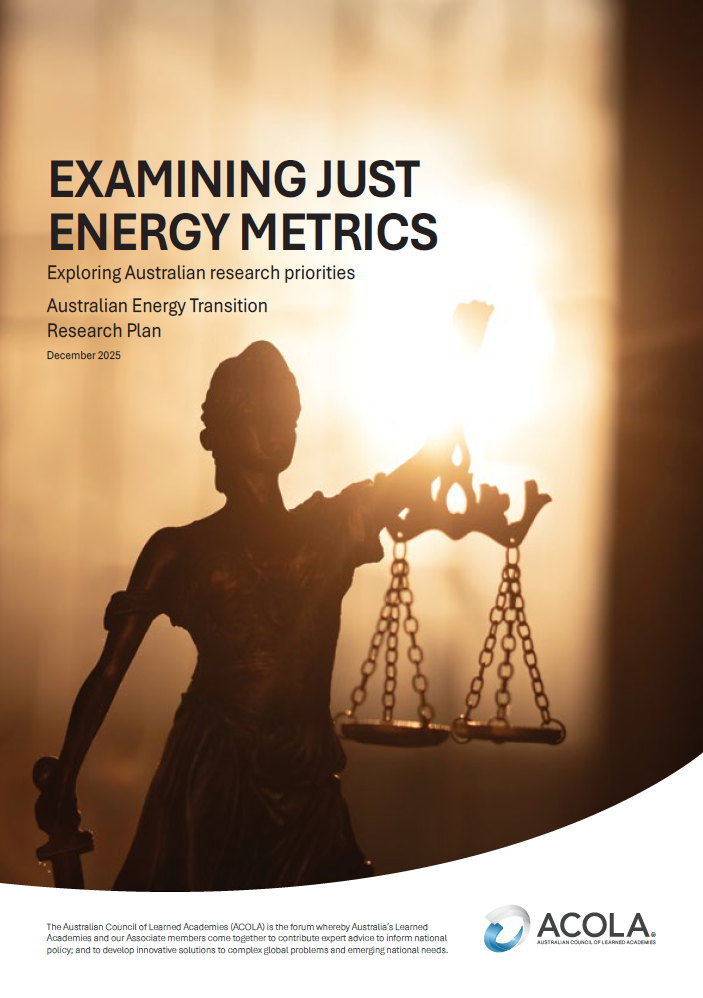
Examining JUST Energy Metrics: Exploring Australian research opportunities

{{ vc_btn: title=Download+the+factsheet&style=custom&custom_background=%231a72bf&custom_text=%23ffffff&align=center&css=&link=url%3Ahttps%253A%252F%252Facola.org%252Fwp-content%252Fuploads%252F2025%252F12%252FACOLA-Examining-Just-Energy-Metrics-Factsheet_1Dec_high-res.pdf }}{{ vc_btn: title=Download+the+report&style=custom&custom_background=%231a72bf&custom_text=%23ffffff&align=center&css=&link=url%3Ahttps%253A%252F%252Facola.org%252Fwp-content%252Fuploads%252F2025%252F12%252FACOLA-Examining-Just-Energy-Metrics-Report_1DEC_High-res.pdf }} Examining JUST energy metrics: Exploring Australia research opportunities  Australia’s shift to renewable energy is accelerating, reshaping communities, economies and landscapes nationwide. Yet while the nation pushes toward ambitious 2030 targets, one challenge remains largely unresolved: how do we measure whether the transition is fair? Technology is advancing rapidly,…

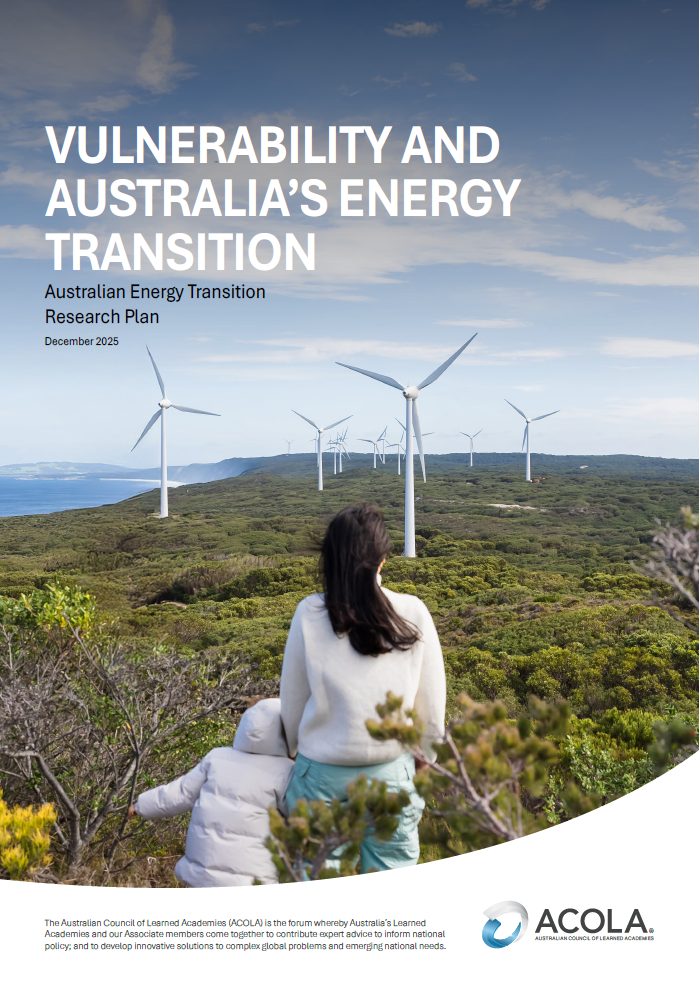
Vulnerability and Australia’s Energy Transition

{{ vc_btn: title=Download+the+factsheet&style=custom&custom_background=%231a72bf&custom_text=%23ffffff&align=center&css=&link=url%3Ahttps%253A%252F%252Facola.org%252Fwp-content%252Fuploads%252F2025%252F11%252FACOLA-Vulnerability-and-Australias-Energy-Transition-Factsheet-2025.pdf }}{{ vc_btn: title=Download+the+report&style=custom&custom_background=%231a72bf&custom_text=%23ffffff&align=center&css=&link=url%3Ahttps%253A%252F%252Facola.org%252Fwp-content%252Fuploads%252F2025%252F11%252FACOLA-Vulnerability-and-Australias-Energy-Transition-Report-2025.pdf }} Vulnerability and Australia’s Energy Transition: Why Understanding Risk Matters   Australia’s transition to renewable energy will reshape daily life, local communities and the national economy. While much attention has been given to technologies and emissions targets, far less has focused on a critical question: who is most vulnerable…

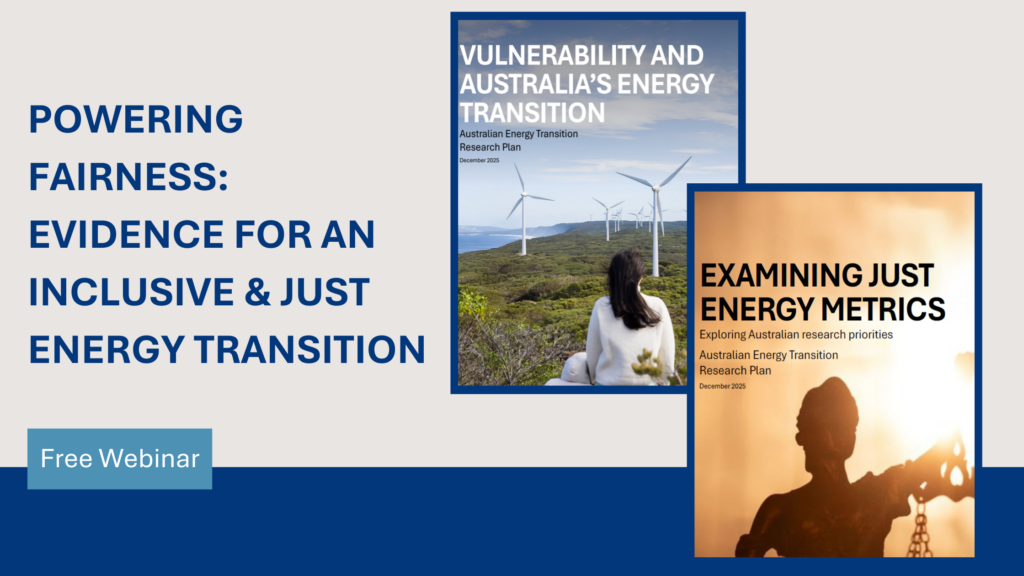
Powering Fairness: Evidence for an Inclusive and JUST Energy Transition | Webinar

A fair energy transition for all Australians begins with evidence. Watch the full webinar Australia’s transition to renewable energy is reshaping communities, economies and everyday life. Yet the impacts—and benefits—are not felt equally.  Join ACOLA and leading experts as we explore the findings of two significant reports that offer practical frameworks, policy insights and tools to support a fair, inclusive transition to net zero.  This…

Briefing Papers on Australia’s Energy Transition Research Plan

Release of Energy Transition Research Plan Briefing Papers Following discussion with Academy Fellows and stakeholders, ACOLA today released three briefing papers identifying urgent and strategic energy transition research priorities. The thematic briefing reports (reports three to five) expand on the research priorities outlined in ACOLA’s Australian Energy Transition Research Plan (Report One). Released on 17…

Photograph of Kenneth Baldwin
Kenneth Baldwin
Lesley Head
Photograph of Fran Baum
Fran Baum
Thomas Maschmeyer
Photograph of Sue Richardson
Sue Richardson
Merryn York
Steering Committee

The Research Plan is led by an ACOLA Steering Committee consisting of experts and Fellows from Australia’s Learned Academies that bring their multidisciplinary expertise across the energy and research sector . The Steering Committee provides strategic oversight, expert input, analysis and provocative thinking.

Project Management

The overall governance and monitoring of the Research Plan is led by ACOLA, an independent, not-for-profit research organisation.

Dr Tina Parolin Dr Lauren Palmer

We want to acknowledge past ACOLA research/project staff and external researchers who have assisted with this project:

Dr Fern Beavis Ms Stephanie Chan
Dr Reza Fazeli Ms Judita Hudson
Professor Tina Soliman Hunter Associate Professor Madeline Taylor
Dr Vlado Vivoda


For further information or any queries about the project, please contact:

info@acola.org.au

Funding Partners for the Australian Energy Transition Research Plan

ACOLA gratefully acknowledges the support and contribution to the project. This project is supported by the Australian Government Australian Renewable Energy Agency (ARENA), Commonwealth Scientific and Industrial Research Organisation (CSIRO), and National Energy Resources Australia (NERA).

The views and opinions expressed in this Research Plan are those of ACOLA and the Steering Committee, and do not necessarily reflect the opinions of NERA, CSIRO and ARENA.

ACOLA also acknowledges and is grateful for funding from the Ian Potter Foundation which is supporting work to explore the future of continuing this important project.

ACOLA acknowledges all Aboriginal and Torres Strait Islander Traditional Custodians of Country and recognises their continuing connection to land, sea, culture and community. We pay our respect to the Elders both past and present.