
Disability responsiveness is the state of a worker's attitudes and behaviours towards people with disability.
ACOLA / Enhancing Disability Responsiveness of Professionals (2022)
Why the definition matters
Responsiveness is not a box that gets ticked at induction. It sits on a continuum, from actions that cause harm through to practice that consistently upholds the rights of people with disability.
That framing changes what training has to do. It has to shift attitudes as well as knowledge, it has to be practised on the job, and it has to be developed with, or by, people with disability.
Seven years of building the case, and the capability
Each step in this program was built on the one before it. The through line is simple: listen to people with disability, then change what professionals are taught.
2019 to 2023: The Disability Royal Commission hears the problem
The Royal Commission into Violence, Abuse, Neglect and Exploitation of People with Disability documented what people with disability had been saying for years: barriers to inclusion run right across Australian services and workplaces.
2022: ACOLA is asked to find the pathway
Under Australia's Disability Strategy 2021 to 2031, the Department of Social Services engaged ACOLA to examine how training could better equip the education, health, justice and social services workforce.
2022: Ensuring Occupations are Responsive to People with Disability
ACOLA's award winning report delivered a Good Practice Guide, an Action Plan, and an Education and Training Analysis Tool, along with Easy Read and Plain English versions so the findings were available to the people they concern.
November 2025: An $18 million national commitment
The Australian Government announced an $18 million package to break down barriers and shift attitudes. ACOLA received $3 million to lead one of its key programs, commissioned by the Department of Health, Disability and Ageing.
2026 to 2028: Toolkits and a National Roadmap
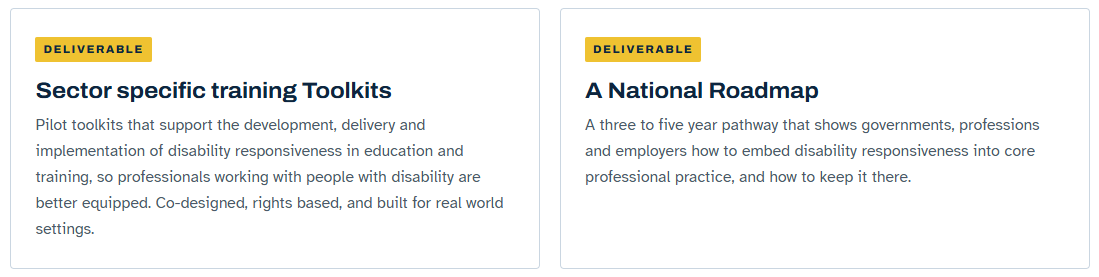
The Disability Responsiveness Program is now underway: sector specific training toolkits, co-designed with people with disability, and a National Roadmap that sets out the systemic change professions need over the next three to five years.
Six principles that make training work
ACOLA's 2022 report identified the principles associated with more positive interactions between professionals and people with disability. They are the foundation every toolkit is built on.
Nothing about us without us
Education and training about disability must be developed and delivered with, or by, people with disability.
Capability areas
Training must build skills, knowledge and attitudes together, not one at the expense of the others.
Experiential learning
Training must include learning that happens on the job, in the settings where practice actually occurs.
Addressing bias
Training should strengthen a learner's ability to reflect critically on their own attitudes and behaviours.
Fit for purpose
Content has to match the occupation, the setting and the people the workforce serves.
Quantum
One course will not deliver disability responsiveness. It takes an ongoing commitment over time.
Five areas where change has to happen
The Action Plan set out what governments, training providers, professional bodies and employers each need to do. These five areas now shape the program's priorities.
Area 1: Active participation
People with disability hold a clear, visible and valued role in leading the training.
Area 2: Sector planning and actions
Training is tailored and timely, focused on what workers and their communities actually need.
Area 3: Training packages
People with disability can have confidence in the skills and capabilities of every professional who supports them.
Area 4: Knowledge collection
Australia holds the evidence needed to monitor progress on disability responsiveness over time.
Area 5: Government leadership
Governments work together on a shared, collaborative approach to an inclusive society.
The Program: 2026 to 2028
What we are building
Two deliverables, designed to be used rather than filed. ACOLA is engaging professional and industry bodies early, starting with the professions that have made disability responsiveness a priority and are ready to change what they teach.
What the program sets out to achieve
- Uplift the capability of professionals working with people with disability, through training that is designed to be adopted.
- Increase knowledge of disability by transforming education, training and development programs to embed disability responsiveness.
- Increase the involvement of people with disability in key industry professions.
The outcome we are working towards: reduced harm towards people with disability, through improved community attitudes and stronger opportunities for social participation, employment and everyday inclusion in a more disability responsive Australia.
The program aligns with Australia's Disability Strategy 2021 to 2031, reinforcing national work on community attitudes, inclusion and workforce capability.
How we work
Co-design, then structure, then evidence
Lived experience leads
People with disability are involved through every phase of the project, including the Steering Committee and the Expert Advisory panels. The Toolkits and Roadmap are co-developed with, and by, people with disability.
Interdisciplinary advice
ACOLA convenes Australia's five Learned Academies and their combined membership of more than 3,500 experts, then brokers connections across government, industry, community and research institutions.
Broad, deliberate engagement
Stakeholders across multiple sectors and occupations take part through interviews, surveys, roundtables and toolkit testing, both in person and online, at each key stage of the project. Relevance and acceptance are tested, not assumed.
Measured, not assumed
A monitoring, evaluation and learning framework tracks whether the Toolkits change practice, so evidence of what works is captured for the sectors that follow.
Governance
The program is guided by a Steering Committee that sets direction and holds the work to account, and an Expert Advisory panel that brings deep disciplinary and lived experience knowledge to each stage of design and testing. 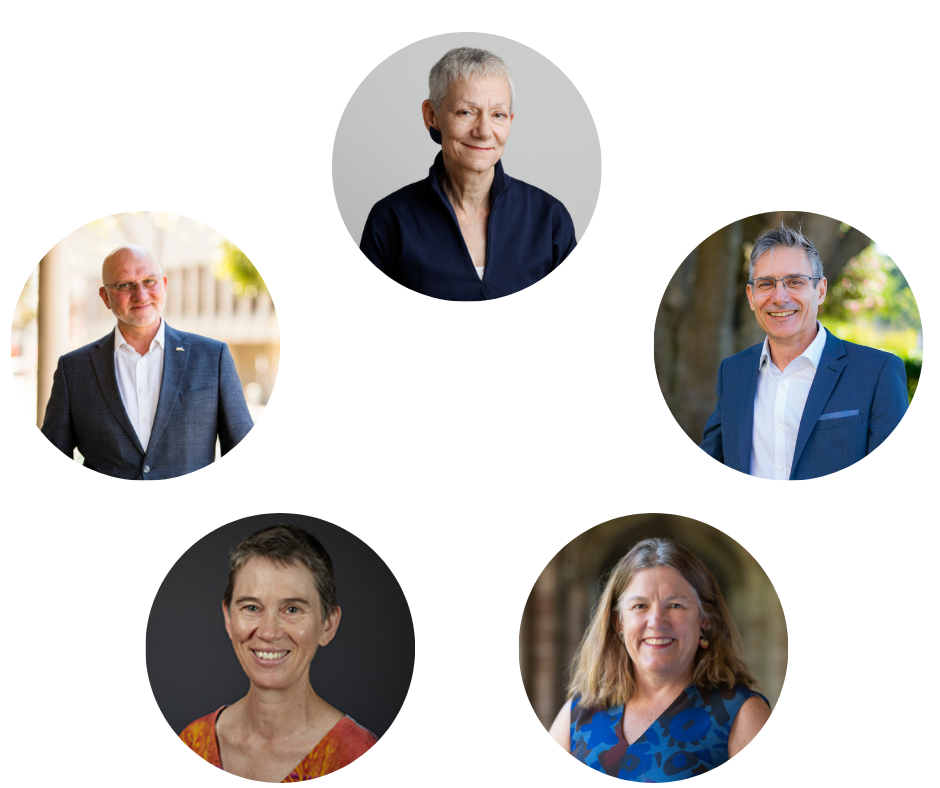
Steering Committee
- Professor Jackie Leach Scully FAcSS FAHA FRSN
- Dr Erol Harvey FTSE CEng
- Professor Anne Kavanagh FASSA FAHMS
- Professor Karen Fisher FASSA
- Professor Julian Trollor AM FAHMS
Expert Advisory Panel
- Professor Catherine Sherrington FAA FAHMS
- Professor Iva Strnadova PhD
- Professor Christine Bigby AO, FASSA
- Professor Steve Robson
- Professor Monica Cuskelly
- Dr Ebe Ganon PhD
- Professor Eileen Baldry AO FASSA FRSN FANZSOC
- Dr Dimity Dornan AO FTSE
- Emeritus Professor Branko Celler FTSE
- Dr Laura Davy PhD
- Dr Dinesh Palipana OAM MBBS FRACGP
Get involved
This only works if professions build it with us
ACOLA is engaging professional and industry bodies, educators, employers and people with disability across the life of the program. If your sector is ready to move, we want to hear from you.
Professional and peak bodies: help shape a toolkit for your profession, from scoping through to piloting, and take the results back to your membership.
Universities and training providers: test the materials in your courses and tell us what has to change before they will work in a real curriculum.
Employers and services: pilot the toolkits in your workplace and contribute evidence on what shifts practice on the ground.
People with disability: join the consultations, advisory panels and testing that direct this work. Nothing about us without us is a working method here, not a slogan.