

While many people with disability successfully navigate services without impact, others experience exclusion, discrimination and marginalisation.
This evidence is visible in processes such as Australia’s Disability Strategy 2021–2031 (Disability Strategy) and submissions to the Royal Commission into Violence, Abuse, Neglect and Exploitation of People with Disability (Disability Royal Commission).
Under Australia’s Disability Strategy, in early 2022, ACOLA was engaged by the Australian Government Department of Social Services to determine how to enhance the training outcomes of occupations across the education, health, justice and social services workforce, to better respond to the needs of people with disability [Outcome Area – Community Attitudes, Policy Priority 2].
The project, Ensuring Occupations are Responsive to People with Disability, explored the context and adequacy of training about disability in Australia and, through this work, ACOLA developed a Good Practice Guide and Action Plan that identified areas for action by all stakeholders, including all levels of government, professional bodies, employers, training bodies (i.e. VET and universities), and individuals.
The Good Practice Guide outlines objectives and principles for good practice in training development, delivery and evaluation. It also provides a practical Education and Training Analysis Tool to ensure education and training align with the knowledge and practice associated with better responsiveness towards people with disability.
ACOLA took an evidence-based approach to this project to explore the context and adequacy of training about disability in Australia. Reflecting concerns of people with disability, we paid particular attention to occupations within education, healthcare, justice and social services sectors.
In line with disability rights-based frameworks, which underpin this project, the voices of people with disability were prioritised in the evidence and analysis considered. This informed a conceptual framework for understanding disability, how many Australians live with disability, and what intersectional factors can make life harder for people with disability, to inform what should be considered in training that enhances occupations’ disability responsiveness.
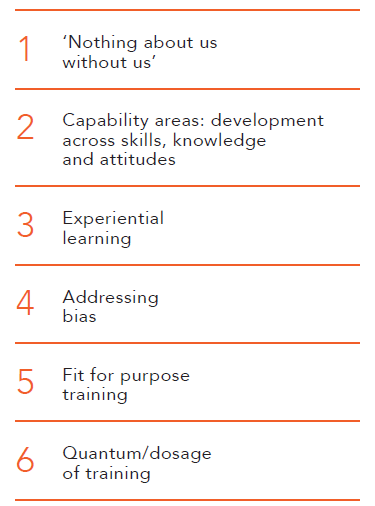
Six key principles to enhance the training for all occupations were identified. These principles are associated with more positive interactions with people with disability:
‘Nothing about us without us’: Education and training about disability must be developed and delivered with, or by, people with disability
Capability areas: Training must develop skills, knowledge and attitudes
Experiential learning: Training must include “on the job” learning
Addressing bias: Training should enhance a learner’s ability to critically reflect on their attitudes and behaviours towards people with disability
Fit for purpose: Training must enhance a learner’s ability to critically reflect on their personal attitudes towards and perceptions of people with disability
- Quantum: Disability responsiveness will not be achieved through a single training event or course. Ultimately, outcomes will require an ongoing commitment.
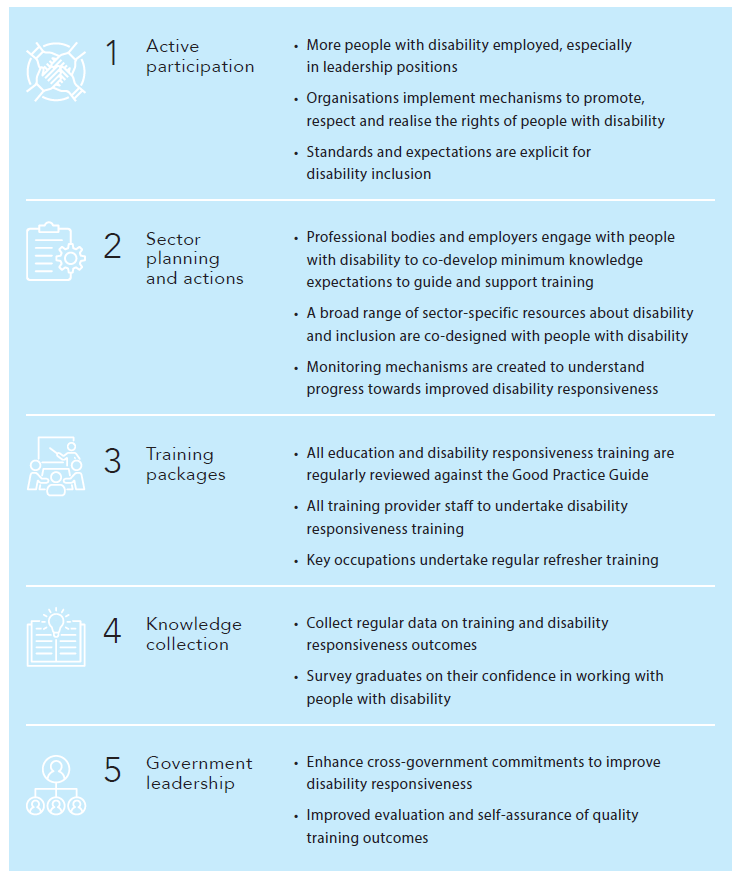
The Action Plan identifies actions for all stakeholders to adopt and implement the Guide and move the training system forward for a more equitable Australia. The plan includes broad and sector-specific opportunities for governments, training providers, professional and industry bodies.
There are five key areas for action to drive improvements in the training occupations receive to improve outcomes for people with disability.
Active participation: People with disability play a clear, visible and valued role in the leadership of the training
Sector planning and actions: The training of occupations is tailored, timely and focused on the needs of workers and the community they serve, especially people with disability
Training packages: People with disability have confidence in the skills and capabilities of all professionals to support them
Knowledge collection: Australia has the knowledge to better include people with disability, monitor developments and progress to address disability responsiveness
- Government leadership: Australian governments share a collaborative approach to progressing an inclusive society.
People with disability represent a significant percentage of Australia’s population. While they have the right to be active and equal members of society and local communities, many people with disability describe a range of negative experiences when engaging with people in service roles and society at large. These negative experiences are amplified by layers such as gender, cultural identity, language, sexuality, location and income which can compound marginalisation and disadvantage.
These experiences have resulted in poor access to services, or in some instances exclusion, which can lead to poorer health and wellbeing. Notably, people with disability report the education, healthcare, justice and social service sectors to be most impactful and problematic in their responsiveness towards people with disability. This has enduring social, cultural and economic costs for people with disability, and for Australia more broadly.
Training and professional development of occupations, along with improvements to legislation, regulation, workplace structures, policies and culture, will play a crucial role in developing occupational and workplace responsiveness towards people with disability. The quality and quantity of training in occupations related to disability responsiveness have been sporadic. Domestic and international research shows that the quality of training is influenced by course design, content and delivery. The final section of this report (Part D – Good Practice Guide and Action Plan) provides a guide on course content to improve disability responsiveness and suggests actions for system-level changes. Disability responsiveness, in the context of an occupation, is broadly defined as the state of a worker’s attitudes and behaviours towards people with disability.
A range of sectors and occupations are committed to making improvements. There are also sound courses and resources developed by disability organisations. However, there are challenges to improving occupation-specific training, including resourcing, content development and prioritisation. There are clear areas for growth and greater focus.
The academic evidence and reports of experiences highlight that improvements in the training that occupations receive needs to be multi-faceted and target all levels of the system, from course content through to monitoring and evaluation. While every occupation and course has different requirements, there are six key principles for guiding good practice for education and training.
There are actions training providers, professional bodies, employers and governments should consider for improving disability responsiveness across occupations, as follows:
Change is always difficult, but there is a pathway. Through this project, we have identified what is needed to help sectors and occupations better respond to people with disability.
- Ensuring Occupations are Responsive to People with Disability - media release
- ACOLA puts words into action on disability responsiveness - media release
- ACOLA-Disability-Responsiveness-Easy-Read-2022.pdf
- ACOLA-response-to-Disability-Responsiveness-Report-2022.pdf
- acola-ai-input-paper_disability_murphy-hollier.pdf
- ACOLA-Disability-Responsiveness-Plain-English-2022.pdf
- SOCIAL-DECK-ACOLA-engagement-insights-report.pdf
Reflecting ACOLA’s convening power of Australia’s leading minds and expertise to deliver interdisciplinary evidence-based advice, ACOLA has convened an Expert Working Group (EWG) to guide the development of this project. This group draws input from several disciplines to create a well-considered, balanced and peer-reviewed report. The role of the EWG is to provide strategic oversight and provide expert input, analysis and provocative thinking.







We also acknowledge the important contributions from external researchers who have assisted with this project.