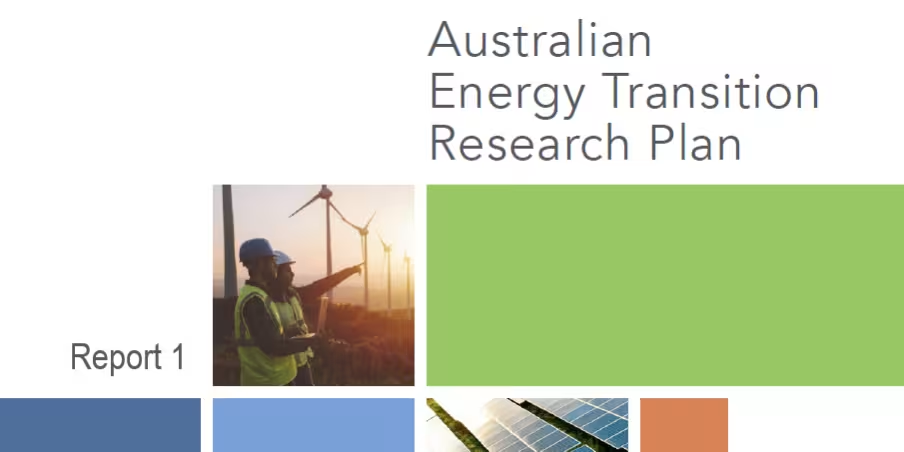
ACOLA is pleased to present the first iteration of the Research Plan, which was made possible by the extensive contributions provided by the Learned Academies, research scholars and practical policy makers in academia, government, industry, community groups, and other key stakeholders. We look forward to the next steps in an ongoing conversation that enables the full range of relevant research organisations across government, industry and the philanthropic sector to support the urgent task of Australia’s energy transition.
Australia’s energy system is embarking on a transformation at a scale and rate that is unparalleled. Nations, leaders, industries and communities acknowledge the imperative to address global climate change through an “energy transition”. The goal is to reach ‘net zero emissions’ (nominally by 2050 or earlier) to halt further global greenhouse gas emissions, which are contributing to rising global temperatures and causing potentially irreversible damage to our societies, physical infrastructure and ecosystems.
Australian Energy Transition Research Priorities Themes and Topics
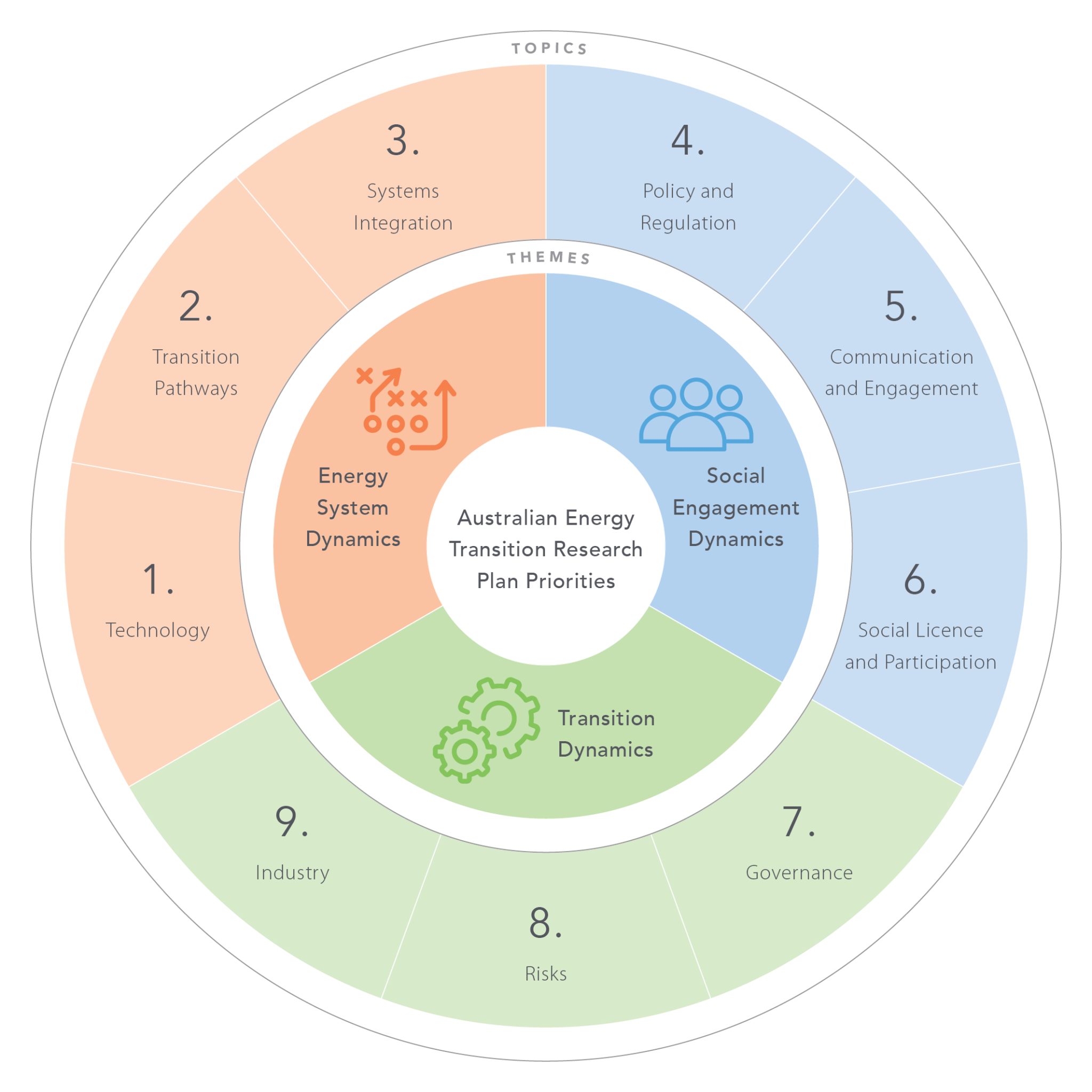
The Research Plan (Report 1) identifies the urgent and strategic research priorities (and critical gaps) that require assessment for a successful Australian energy transition. The initial research priorities, as developed by ACOLA in consultation with stakeholders, are illustrated in the diagram below.
The research priorities are organised into three themes, each with three topics. While the Research Priorities are presented in a static, one-dimensional structure, the order of the list merely provides a structure to communicate a dynamic multi-dimensional proposition. It is not representative of the order of the importance of priorities.
In considering the identified gaps and highest priority areas, researchers and research funders can direct research efforts and funding to accelerate national efforts. We encourage funders to utilise the priorities in their funding guidelines and assessment of applications, to help ensure funding has the most impact or benefit.
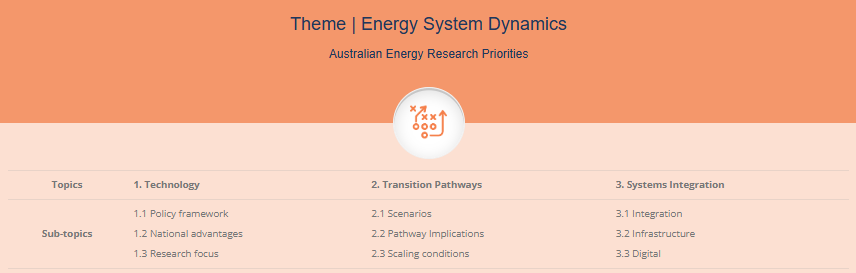
Energy System Dynamics
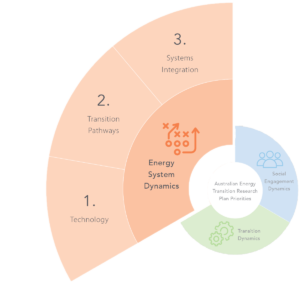
Encompassing the technologies that we will need, how they will be integrated, and the pathways for their deployment and the associated retirement of legacy energy systems.
1. Technology
Technological innovation in renewables, energy efficiency and storage will be essential in facilitating the rate and scale of the energy transition. Mature technologies should be continually improved to increase efficiencies, while emerging technologies require sustained R&D to drive down production costs and encourage uptake. The Australian Government has identified priority technologies (and several emerging, enabling and ‘watching brief’ technologies) for government and industry support, with an annual review cycle. International innovation and market forces will also play a decisive role in the technology options and innovation pathways that Australia pursues. A close watch needs to be kept on emerging technologies, that are not currently on the radar.
2. Transition pathways
There will be multiple, dynamic social, techno-economic pathways to reach a net zero emissions energy system by 2050 or earlier (most assuming massive renewable electrification with storage and a new hydrogen industry, to replace coal, oil and gas). The actual pathway and technology mix will evolve, with the extent and timing of sectoral coupling, clean energy exports and scaling issues being significant uncertainties. These pathways should be explored in an interdisciplinary manner; considering the social, cultural, technical, geo-political and economic dynamics of these pathways; how they will evolve; and the roles that the various actors need to adopt to optimise national outcomes.
3. Systems integration
The energy ecosystem is a complex system of systems with multiple interdependencies (supply chains, physical infrastructure, markets and the regulatory system and end user impacts), all now being disrupted. We need to understand how these systems interact with each other and with other sectors across the disciplines, as well as wider impacts and linkages for significant co-benefits (such as the impact of the transition on population health). Further research on the data and tools to support the transition will also be required.
Social engagement dynamics
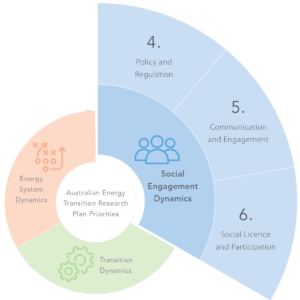
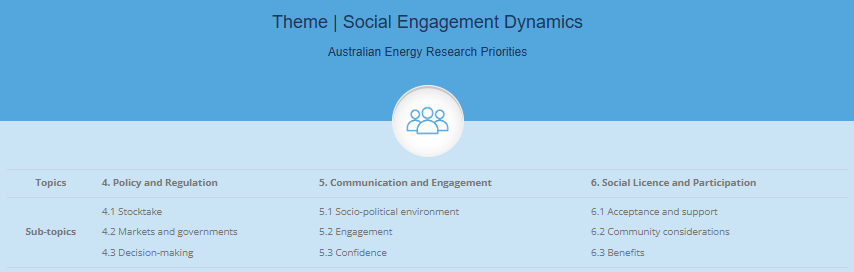
Encompassing the policy and regulatory settings that will be required for the transition, how people (individuals, communities, regions etc) will be engaged, and how principles of equity, justice and fairness throughout the course of the transition will be developed and applied.
4. Policy and regulation
Government (Commonwealth, state/territory and local) policy and regulation can facilitate or impede a successful energy transition. We need research to support best‑practice energy-related policy and regulatory architecture within the context of the Australian political economy. Electricity markets are currently being re‑designed; while this is essential, further work will be required.
5. Communication and engagement
Effective engagement on the impacts of the transition to diverse audiences is essential. Political ambition for the energy transition remains a complex and divisive issue in Australia. We need to better understand why this issue has been so divisive, and the values, impacts and perspectives of different communities and individuals in the transition towards a net-zero economy and society. A successful transition will need effective communication, genuine engagement, community support, and consumer, prosumer and investor confidence.
6. Social licence and participation
National and local support will be critical to a successful transition but cannot be taken for granted. The new energy system is shifting to a more decentralised system with greater choice for users in the production, storage, and use of energy. Justice, equity, fairness, health and wellbeing should apply across social and geographic contexts, with particular consideration of the impacts on disadvantaged communities or households. For an inclusive transition, we need to better understand perspectives and values to facilitate genuine engagement with, and participation of, communities, at all scales and across all sectors.
Transition Dynamics
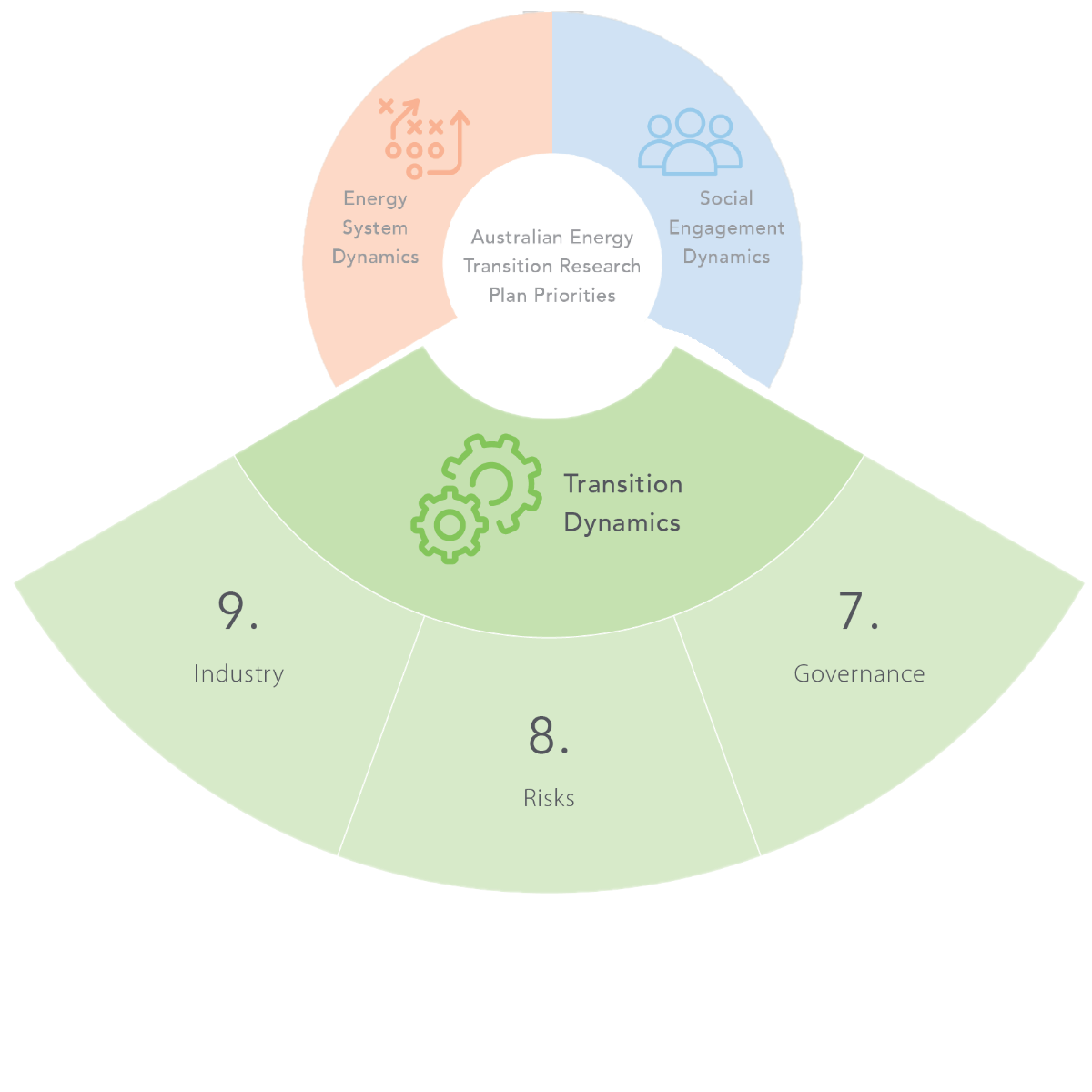
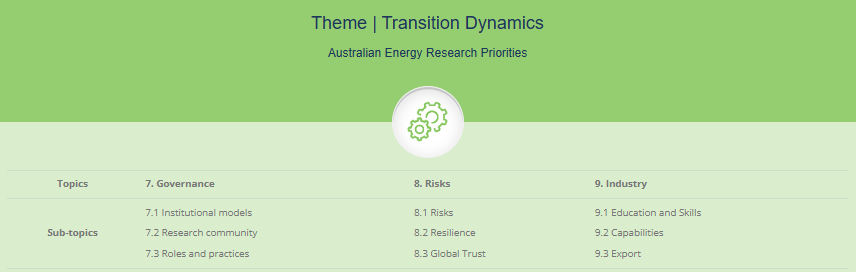
Encompassing the governance structures that we will need, how we will manage the economic, health and social risks, and how industries and employment will be transformed.
7. Governance
Government, regulatory bodies, research, industry, NGO and community energy-related institutions all have important and distinct roles in the governance and management of the transition. Many, however, were established before the energy transition commenced at scale. We need to consider how current energy‑related governance structures and institutions can be optimised to enhance governance, collaboration and decision‑making. Evaluation of research translation into policy will also be important.
8. Risks
There will be risks associated with the transition, particularly as dynamic, alternate pathways continue to evolve and new risk scenarios inevitably arise. Interdisciplinary research will help us navigate the unintended or negative impacts of the transition (across areas such as health, environment, economy and society). However, the transition also represents numerous opportunities to transform our society, economy and industries. Growing a successful renewable/low emissions industry will maintain Australia’s position as a global energy exporter and encourage domestic economic growth and stability.
9. Industry
A strong, evolving Australian industry sector to support a net zero emissions economy will be underpinned by a mix of skills, capabilities, stable and strategic investment flows, collaboration across the innovation chain, and an understanding of Australia’s role in the global energy market. We will need to consider whether Australia has the necessary skills and capabilities, self-reliance, and export potential, to develop these in the required volumes, and how these might be enhanced.
Australia’s energy system is embarking on a transformation at a scale and rate that is unparalleled. Nations, leaders, industries and communities acknowledge the imperative to address global climate change through an “energy transition”. The goal is to reach ‘net zero emissions’ (nominally by 2050 or earlier) to halt further global greenhouse gas emissions, which are contributing to rising global temperatures and causing potentially irreversible damage to our societies, physical infrastructure and ecosystems.
A ‘business as usual’ trajectory is no longer feasible; the window for the transition is narrowing fast, and the cost of inaction on our economy, communities, businesses and environment continues to compound. The global momentum t wards net zero emissions is also rapidly accelerating, which will impact global trade in commodities, technology and services.
In Australia, governments, industries, citizens and researchers are bracing for the challenge ahead, with growing momentum and support for a rapid and low carbon energy transition. The trajectory to reach net zero emissions, however, will be challenging: as of 2020, fossil fuels provided 94 per cent of Australia’s total energy needs. Australian governments are currently implementing a suite of reforms to address Australia’s electricity infrastructure and energy market. However, much work remains to transform our industries (particularly mining, transport, manufacturing and agriculture), which are still mostly dependent on fossil fuels for their energy requirements, and also contribute substantially to emissions.
Australia also has substantial opportunities to grow our clean energy sector and to become a renewable energy superpower, buoyed by the current success of our solar and wind industries. However, realising these opportunities will require national strategic alignment, innovation and regulation.
Australia must be efficient, responsive and forward-looking if our transition to net zero emissions is to succeed, with as minimal disruption to our economy and society as possible. This also applies to the research sector, which must respond with appropriate research and translation on a time scale reflective of this critical need.
A successful energy transition will be one that addresses the energy trilemma: reliable, affordable and reaching net zero emissions, while also placing the wellbeing of society at its centre. Following extensive engagement with the energy and research sector, four critical challenges have been identified.
While Australian researchers are undertaking critical and valuable research across all disciplines, there is an absence of a scalable and cohesive research agenda to focus efforts on priority issues to guide Australia on the trajectory of transition over the next 10-20 years. Ongoing, strategic and coordinated research activities, in all relevant disciplines, will be critical to achieving a successful and just transition.
Secondly, while international developments will undoubtedly inform our national pathway, we cannot rely solely on international research to address uniquely Australian problems and needs, including our dispersed and diverse populations and geography, our present reliance on fossil fuel resources and our energy infrastructure. Australia must continue to strengthen its domestic research capabilities to find local solutions and strategies that correspond to our local needs and are fair to our society. A strong local research capability will also give us a seat at the international research table and enable the adaptation of international knowledge to Australian circumstances.
Thirdly, the energy transition is an interdisciplinary challenge. Australia performs well in science, engineering and technology-related energy research, and ongoing developments in these fields will be critical to ending our reliance on fossil fuels. However, a successful transition must also encompass the perspectives and wellbeing of people, in the context of their lives, communities, economy and employment, in a way that is fair. Consultations highlighted significant gaps in research on the social aspects of the energy transition, particularly in the Australian context. For example, there is currently little research on how best to provide assistance to communities to effect their own transitions, especially those whose livelihoods depend on high emission industries or live in rural and remote regions. Further, it is vital to ensure Aboriginal and Torres Strait Islander people have a say and lead the energy transitions in their communities.
Finally, all sectors involved in the energy transition, from government, industry, research funders and research organisations, need to respond in a time scale that is reflective of the urgency and enormity of this issue. The translation of research takes time, and we need to continue to look at efficiencies in the way research is funded and undertaken to ensure that outputs are available within the necessary timescales.
As a response to these challenges, the Australian Council of Learned Academies (ACOLA) has developed an Australian Energy Transition Research Plan (Research Plan).
In presenting the Research Plan, ACOLA considers that practical social applications of the energy transition, including equity and justice, should be considered at the outset and in partnership with technical research. The Research Plan aims to shift the current research paradigm by highlighting the Research Priorities (specifically, key research gaps, opportunities and subsequent research questions) that need to be addressed for Australia to transition successfully and rapidly.
Developed by ACOLA, in consultation with stakeholders, the Research Plan’s research priorities are organised into three themes: energy system dynamics; social engagement dynamics and transition dynamics, with three topics under each as shown in Diagram 1.
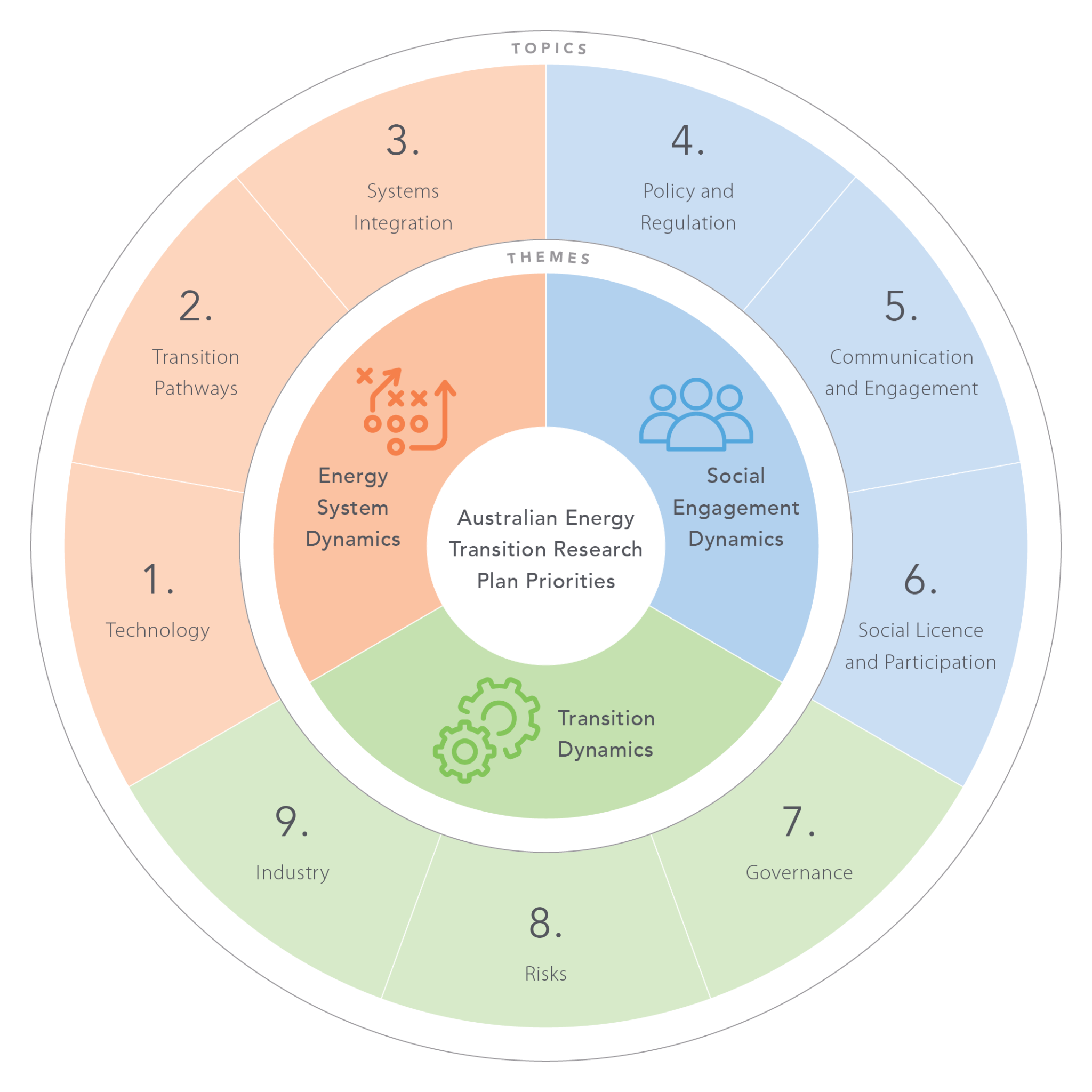
While the Research Priorities are presented in a static, one-dimensional structure, the order of the list merely provides a structure to communicate a dynamic multi-dimensional proposition. It is not representative of the order of the importance of priorities.
Under each topic identified in the Research Plan, three high-level key research questions have been initially identified that will require research and funding over the next decade (see Appendix 1). The questions are classified as either urgent (where robust answers are needed in the near future) or strategic (where robust answers are required in the longer term). While research needs to begin now on all the questions, the Research Plan recognises that research for ‘strategic’ questions may take longer to have an impact. In total, these 27 questions represent the key questions requiring research now; they are likely to change in further iterations of the Research Plan as the transition progresses.
The Research Plan will be an ongoing program of work with periodic review cycles of the equal and complementary Research Priorities. ACOLA will also monitor current and emerging energy research across all disciplines. Regular review cycles will identify current research, emerging research gaps, and, importantly, whether the critical research priorities identified are being pursued. It is expected that new questions will emerge in this iterative process. The purpose of the Research Plan is to offer those in the research ecosystem (researchers, funders and users), guidance on where and what research is being undertaken and what critical research is not being done. This will enable the research ecosystem to direct research efforts and funding to the highest priority areas to accelerate efforts and avoid duplication.
Note, however, that ACOLA is not a funding body and will not be commissioning research through the Research Plan. The shift to a net-zero emission energy system will require large-scale innovation and effort, and inevitably, there will be both successes and failures given the enormity of this task. Australia can minimise unintended impacts or harm by being proactive and engaging end users from the start, through fostering ongoing technological innovation, ensuring that policy and regulatory frameworks are agile to adapt to the changing energy landscape, engaging with communities to gain acceptance and trust, and continuing to fund and make use of interdisciplinary research for Australian solutions and strategies. ACOLA is pleased to present the first iteration of the Research Plan, which was made possible by the extensive contributions provided by the Learned Academies, research scholars and practical policy makers in academia, government, industry, community groups, and other key stakeholders. We also acknowledge the financial contributions by National Energy Resources Australia (NERA), the Commonwealth Scientific and Industrial Research Organisation (CSIRO) and the Australian Renewable Energy Agency (ARENA) for this project. We look forward to the next steps in an ongoing conversation that enables the full range of relevant research organisations across government, industry and the philanthropic sector to support the urgent task of Australia’s energy transition
Media release

Emeritus Professor Sue Richardson
AM FASSA


Emeritus Professor Kenneth Baldwin
FTSE Emeritus Professor of Research School of Physics at The Australian National University
Distinguished Professor Fran Baum
AO FAHMS FASSA




ACOLA gratefully acknowledges the support and contribution to the project. This project is supported by the Australian Government Australian Renewable Energy Agency (ARENA), Commonwealth Scientific and Industrial Research Organisation (CSIRO), and National Energy Resources Australia (NERA).

 logo.jpg)