Transitioning to a low-carbon energy system is one of the defining challenges of the 21st century. Delivering this transformation will require unprecedented investment in energy research, development and demonstration (RD&D) to develop new technologies, scale existing solutions and support the economic and societal changes associated with the transition.
This report examines Australia’s public investment in energy RD&D and compares it with that of key international economies. Drawing on data from the International Energy Agency (IEA) and updated Australian Government information, the analysis highlights how Australia’s reported government investment in energy research has declined relative to comparable nations.
This report aims to improve understanding of Australia’s investment in energy research, development and demonstration by examining publicly available data and comparing national spending patterns with those of key international economies.
Specifically, the report seeks to:
- Analyse trends in Australia’s public energy RD&D expenditure over time.
- Compare Australia’s investment levels with those of similar IEA member economies including Canada, Germany, Korea, Norway, the United Kingdom and the United States.
- Examine how funding is distributed across different energy technology categories.
- Identify limitations in existing international reporting frameworks that may affect how Australian investment is represented.
- Highlight opportunities to improve transparency and understanding of Australia’s total energy RD&D investment.
By providing this analysis, the report contributes to a clearer evidence base to support national discussions on energy innovation, research priorities and investment needed to deliver Australia’s transition to net zero emissions.
- Australia’s reported government RD&D spend is low relative to other key economies.
- From 2004–2020 Australia’s public energy RD&D expenditure on energy has decreased both in absolute terms, as well as relative to comparable countries.
- The scope of the IEA’s methodology does not reflect investments and measures used in Australia, specifically indirect supports such as R&D Tax Incentives (RDTI).
- Gaining a better understanding of Australia’s energy RD&D spend, including RDTI expenditure, could provide important insights into our actual overall RD&D spend.
Transitioning to a low-carbon energy system requires sustained investment in research, development and demonstration to develop new technologies, enable innovation and support large-scale deployment.
Analysis of international data shows that Australia’s reported government investment in energy RD&D is relatively low compared with other advanced economies. Between 2004 and 2020, Australia’s public investment in energy research declined both in absolute terms and relative to comparable countries.
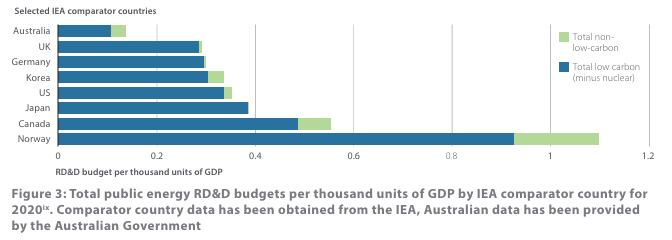
Key findings include:
- Analyse trends in Australia’s public energy RD&D expenditure over time.
- Compare Australia’s investment levels with those of similar IEA member economies including Canada, Germany, Korea, Norway, the United Kingdom and the United States.
- Examine how funding is distributed across different energy technology categories.
- Identify limitations in existing international reporting frameworks that may affect how Australian investment is represented.
- Highlight opportunities to improve transparency and understanding of Australia’s total energy RD&D investment.
Despite methodological limitations in available data, the evidence indicates that Australia’s energy RD&D investment remains comparatively low. If Australia is to achieve its net-zero ambitions through a technology-focused pathway, significantly greater investment in energy research and innovation will likely be required.